
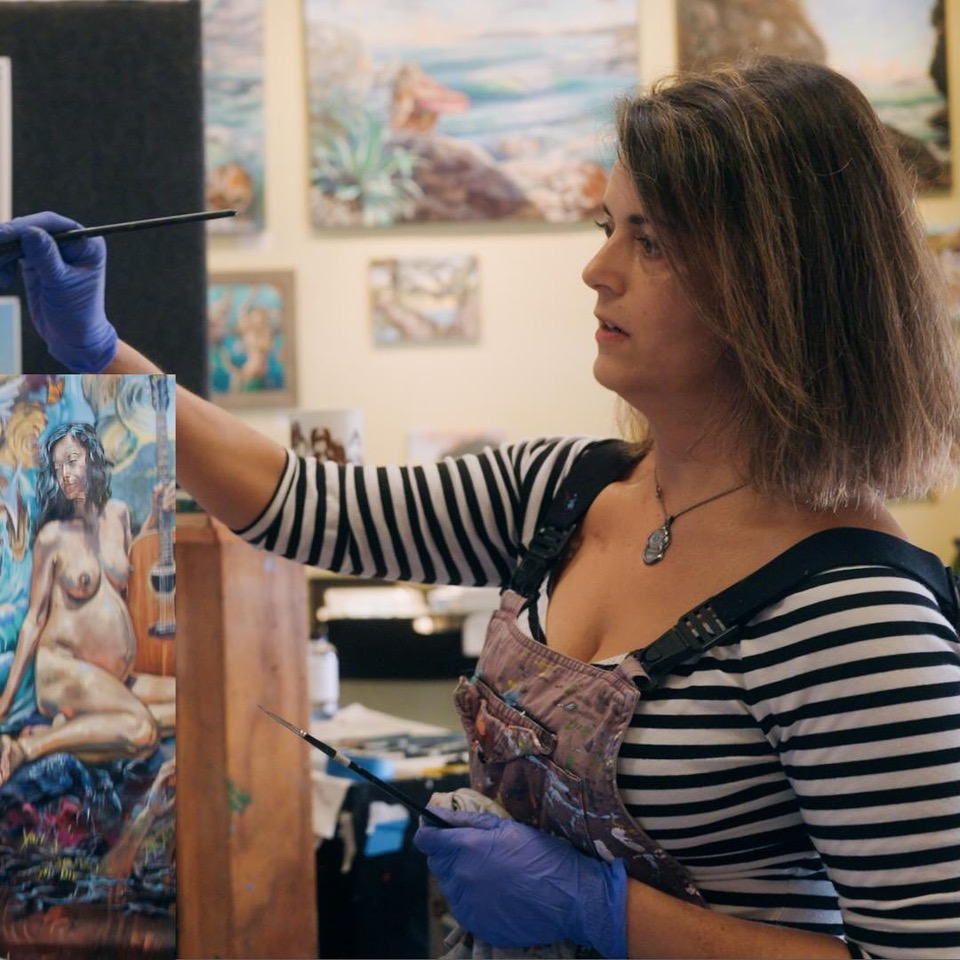
Colleen Gnos's murals are full of life — many featuring ocean scenes or the heritage of farming and agriculture in California. As a fine art muralist, she applies techniques learned during her art studies to grand-scale commissions. Colleen reveals what she enjoys about public art, her family's history of farming, her connection to the land and the ocean, and the influence of music on her work. She also talks about the importance of getting to know the culture and personal history of a community — and where she is headed next on a path of self-discovery.
You call yourself a muralist and fine artist. Do you identify with one category more than with another?
Honestly, the two are inseparable for me, and I think that's what makes my work distinctive. I consider myself a fine art muralist, because I approach every wall exactly the way I'd approach a canvas in my studio: research, prep, layout, building up the work in layers, and constantly balancing the composition as a whole. That discipline comes from a foundation in traditional fine art — studying at UC Santa Cruz, then a year at the Accademia di Belle Arti in Florence, the school founded by Michelangelo. That training never leaves you, whether you're working on a 6x6" canvas or a 65-foot wall from a boom lift.
What I've learned over 30 years is that art trends come and go. Right now, murals are pretty hot, so I've been busy with mural commissions. And there's something I love about the scale of murals — the way a mural can capture someone's attention on a drive down the highway or become a landmark in a community. That's a kind of reach a gallery painting rarely gets.
What I've learned over 30 years is that art trends come and go. Right now, murals are pretty hot, so I've been busy with mural commissions. And there's something I love about the scale of murals — the way a mural can capture someone's attention on a drive down the highway or become a landmark in a community. That's a kind of reach a gallery painting rarely gets.
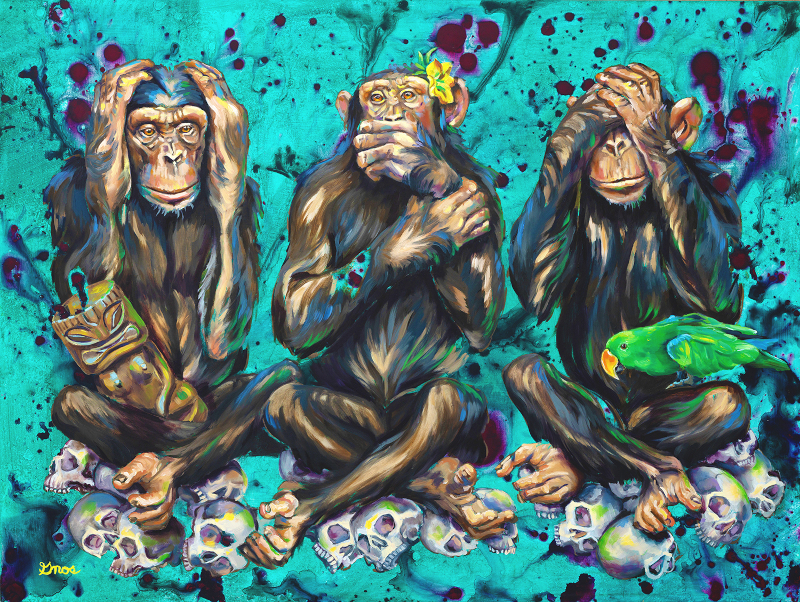
Being a muralist, you are working a lot outside and in public. What do you enjoy about this kind of work? Can you describe a typical day working on a mural?
It feels like hard work and I LOVE getting physical with art materials. There's something about putting movement and strength of the body into a large-scale work outdoors. You can't get that messy indoors. I can really see and appreciate the physicality of painting in many murals and graffiti art in cities, on train cars.
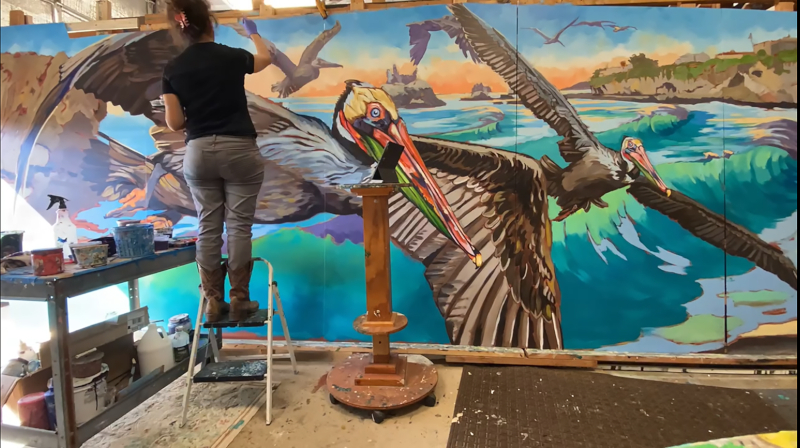
Working outside, there are many factors to consider, especially the weather. I sometimes rearrange my sleep and work schedule around the weather and daylight. I grew up as a farmer's daughter, so it feels closer to the elements. For example, I had a 6-week project in 100–115 degree heat, and the sun hit the wall at 1pm. I woke up at 4am, was on the job site at 5:00am, and off the wall at 1:30pm.
Right now, I'm painting a Chumash kelp forest mural inside an aquarium at a high school in Vandenberg Village. High school students give tours to elementary school children all day while I'm up on a scissor lift painting — I've become part of the exhibit. When the kids come around the corner and see a Chumash freediver with a harpoon or a giant leopard shark painted larger-than-life on the wall, the reaction is pure excitement. Hearing that while I work reminds me why public art matters.
In the previous 10 years, I've created a lot of works on aluminum panel or parachute cloth in my studio. On my last mural in Guadalupe, the neighbors were so touched by the piece that they showed up with homemade cookies, and one family offered me their vacation home in Mexico. It feels like I'm doing something really important for the community.
Working outside, there are many factors to consider, especially the weather. I sometimes rearrange my sleep and work schedule around the weather and daylight. I grew up as a farmer's daughter, so it feels closer to the elements. For example, I had a 6-week project in 100–115 degree heat, and the sun hit the wall at 1pm. I woke up at 4am, was on the job site at 5:00am, and off the wall at 1:30pm.
Right now, I'm painting a Chumash kelp forest mural inside an aquarium at a high school in Vandenberg Village. High school students give tours to elementary school children all day while I'm up on a scissor lift painting — I've become part of the exhibit. When the kids come around the corner and see a Chumash freediver with a harpoon or a giant leopard shark painted larger-than-life on the wall, the reaction is pure excitement. Hearing that while I work reminds me why public art matters.
In the previous 10 years, I've created a lot of works on aluminum panel or parachute cloth in my studio. On my last mural in Guadalupe, the neighbors were so touched by the piece that they showed up with homemade cookies, and one family offered me their vacation home in Mexico. It feels like I'm doing something really important for the community.
Reading your biography, you seem to have traveled to many different places, practiced different art forms, and gone through major life changes in your career. How much does your artwork reveal about your personal life story?
I believe that every painting or mural I create has my life story built into it. It's what connects collectors and viewers with certain artists — they are moved by the artist's essence in their work. I doubt if anyone could single out my own and my son's cancer journeys in my work, or the elation I feel when I surf, play bass, or when I delivered my children, but I think it leaves an overall impression of a life fully lived.
Some of your commissioned murals show your family's ties to agriculture and farming. Can you name some examples on view and share the places, cultural customs, and family values that have shaped you as a person and an artist?
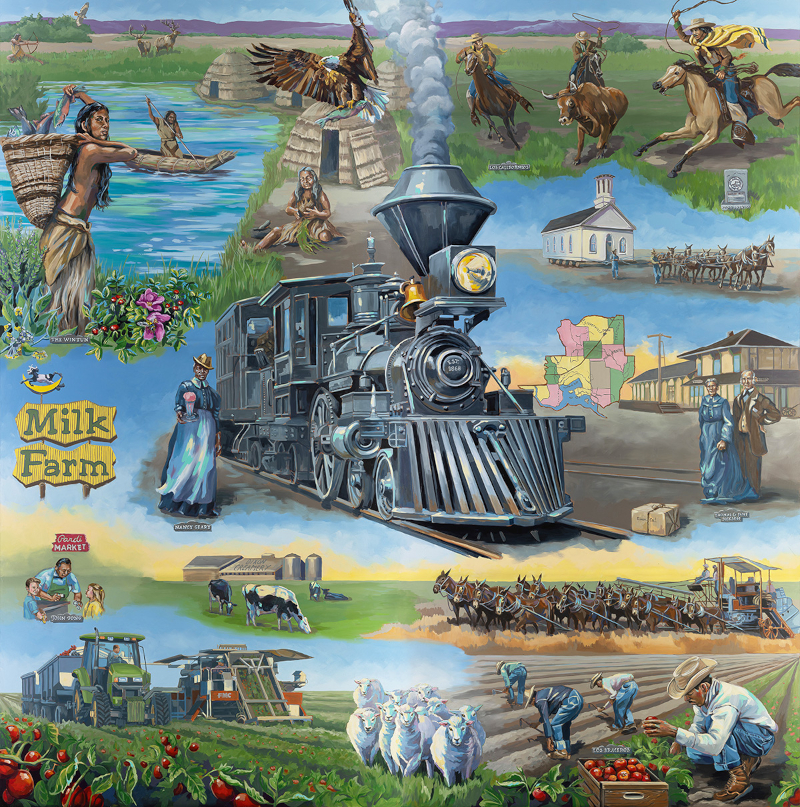
"A History of Dixon" (14'×14') is on view in Dixon, California, commissioned by the Dixon Historical Society and Museum. It includes first settlers, business owners, wildlife, medicinal plants used by Wintun Nation, local landmarks like the Milk Farm and Dixon United Methodist Church, and agricultural industries — including a tribute to my own father's tomato farming.
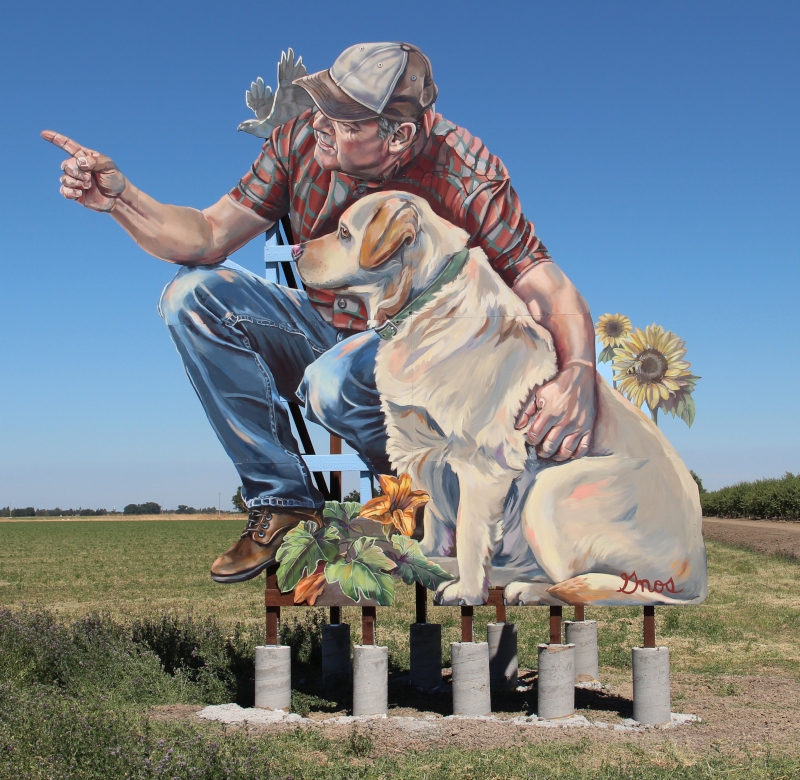
"Stewards of the Soil" is a 20×20' free-standing mural in a field in Dixon, off Interstate 80 East, dedicated to farming families' lifestyle of hard work and their year-round commitment to producing food.
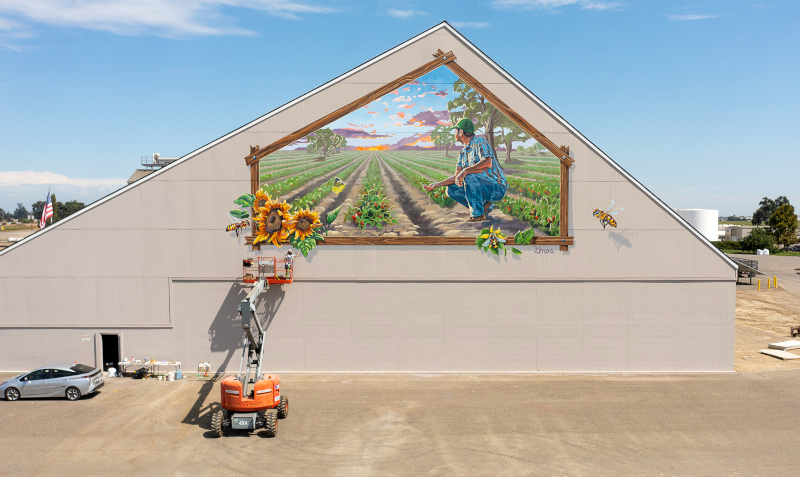
"Gazing Into Infinity" (35'×65') is on view off Highway 113 and I-5 in Woodland, CA. It depicts a hardworking man connected to his farm — and that man is my father, a tomato farmer, lifting a handful of soil to the rising sun, inspired by the morning sunrise drives he would take me on as a child to check the fields.
Halcyon Farms in Oceano, CA features a mural above the produce stand, capturing the farm workers, the family's three daughters, and the incredible variety of vegetables, flowers, fruit, and resident animals on the property.
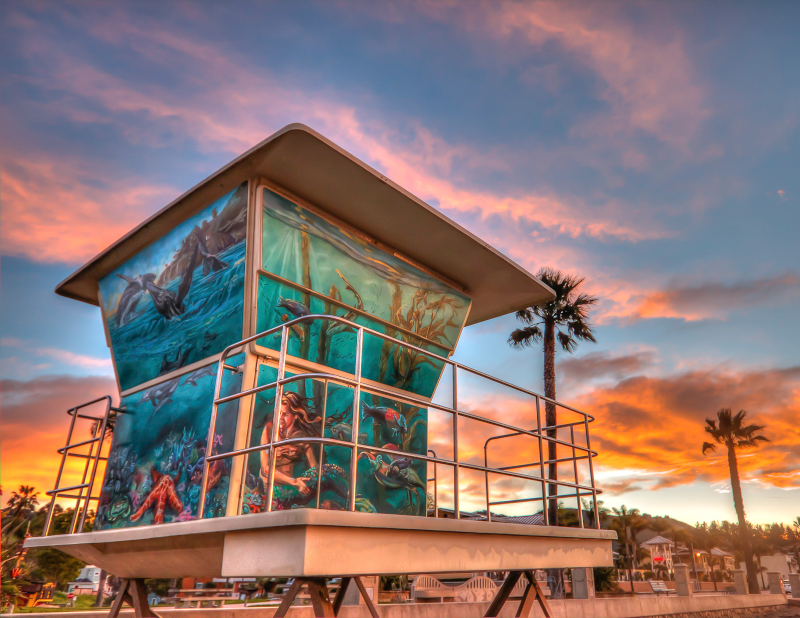
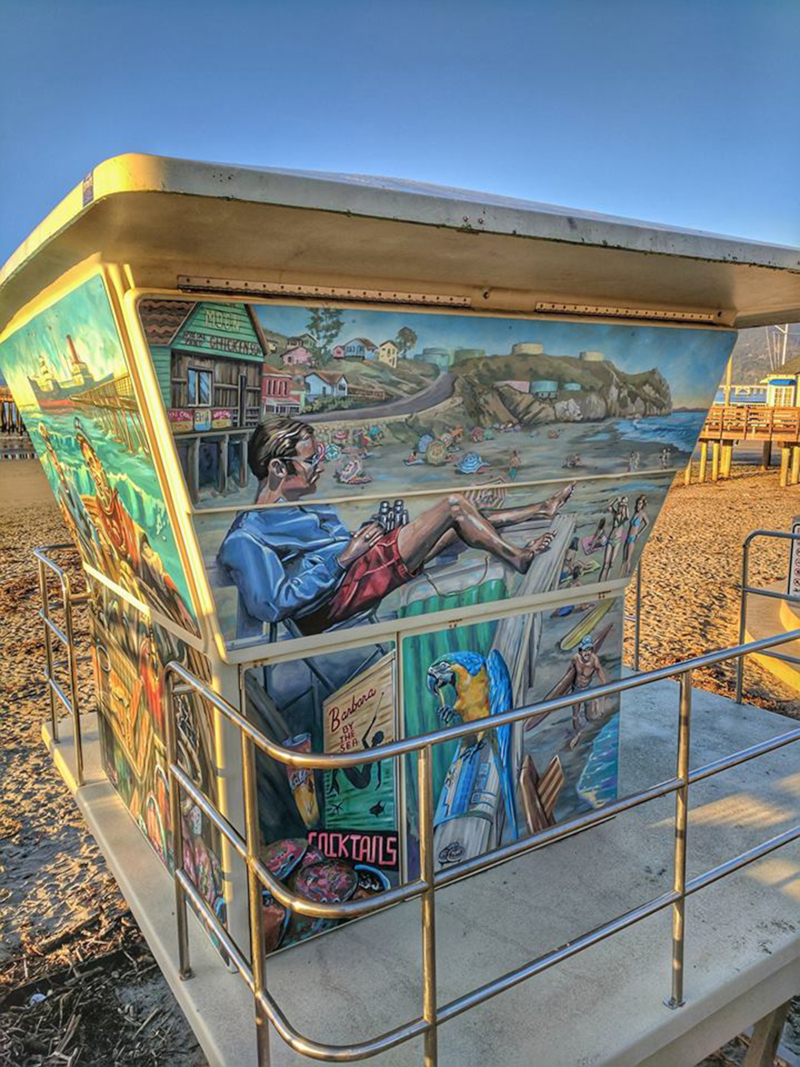
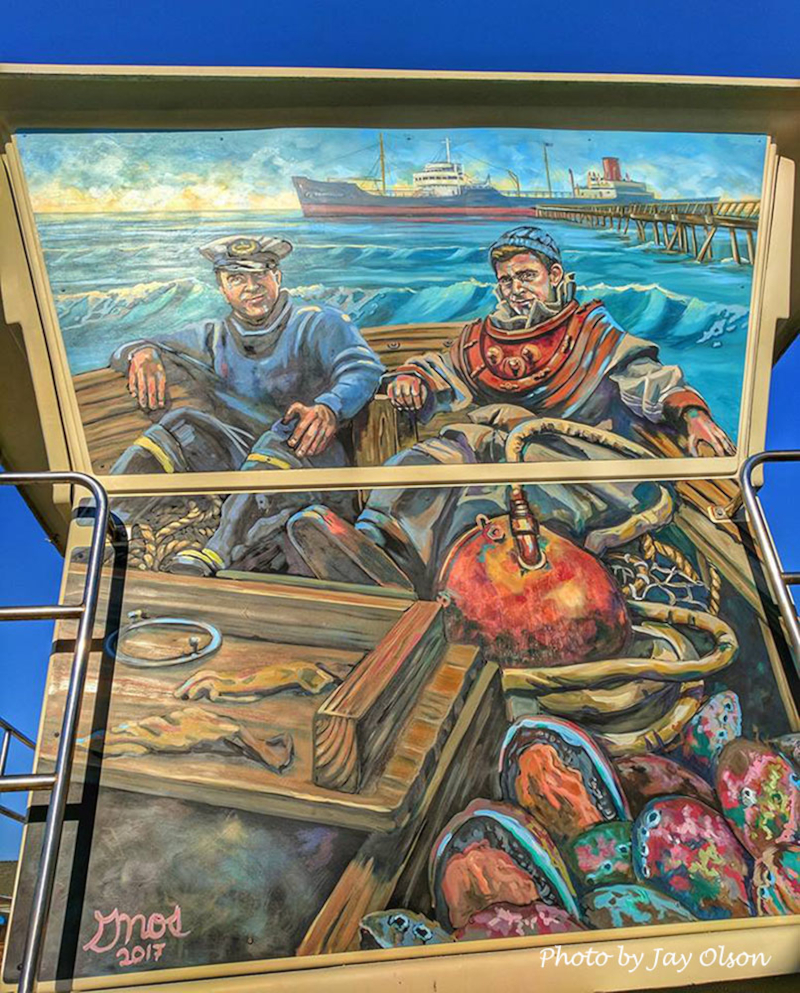
The Avila Beach Lifeguard Towers feature eight interchangeable mural panels celebrating local history — abalone diving, fishing, beach life, and a peek into the future of Avila Beach as an eco-tourist destination. They were voted "Best Public Art Project" in San Luis Obispo County.
As for what shaped me: I grew up in two different worlds. In the farmland near the Sacramento Valley, watching my father harvest tomatoes instilled in me a reverence for the soil, hard physical labor, and the people who feed the world. On the other side of my heritage, my Portuguese grandfather ran a tugboat out of Avila Beach, dove for abalone, and trained Navy divers in the 1930s. My Portuguese ancestors were sea captains in the Azores. That lineage gave me a sense of adventure and a spiritual connection to the ocean that runs through so much of my artwork.
"Stewards of the Soil" is a 20×20' free-standing mural in a field in Dixon, off Interstate 80 East, dedicated to farming families' lifestyle of hard work and their year-round commitment to producing food.
"Gazing Into Infinity" (35'×65') is on view off Highway 113 and I-5 in Woodland, CA. It depicts a hardworking man connected to his farm — and that man is my father, a tomato farmer, lifting a handful of soil to the rising sun, inspired by the morning sunrise drives he would take me on as a child to check the fields.
Halcyon Farms in Oceano, CA features a mural above the produce stand, capturing the farm workers, the family's three daughters, and the incredible variety of vegetables, flowers, fruit, and resident animals on the property.
The Avila Beach Lifeguard Towers feature eight interchangeable mural panels celebrating local history — abalone diving, fishing, beach life, and a peek into the future of Avila Beach as an eco-tourist destination. They were voted "Best Public Art Project" in San Luis Obispo County.
As for what shaped me: I grew up in two different worlds. In the farmland near the Sacramento Valley, watching my father harvest tomatoes instilled in me a reverence for the soil, hard physical labor, and the people who feed the world. On the other side of my heritage, my Portuguese grandfather ran a tugboat out of Avila Beach, dove for abalone, and trained Navy divers in the 1930s. My Portuguese ancestors were sea captains in the Azores. That lineage gave me a sense of adventure and a spiritual connection to the ocean that runs through so much of my artwork.
Which role do mermaids and music play in your life and in your art? What can we learn from the presence of those elements in your work?
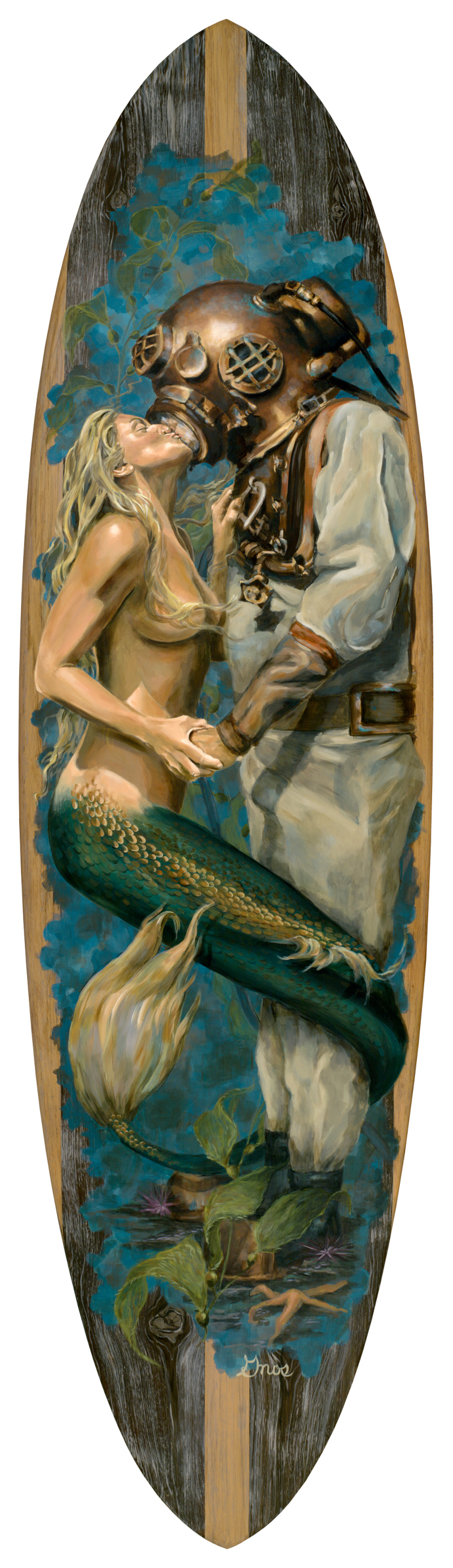
With my connection to the ocean, I spend a lot of my time in the water, so mermaids were a natural transition for me — to combine the conscious (human body) with the unconscious (fish tail) in dream-like imagery. I also enjoy the challenge of painting the human body.
I am an upright bass player, so music has a huge influence on my artistic process. Some of my jazz pieces will start with an abstract composition that I work on while it's flat, splashing color and adding different mediums while listening to music. The music guides the colors and marks I make. When it dries, it often looks very different from when I left it the night before. Then I gaze at the composition and decide which musicians to depict within the abstract colors and shapes.
I am an upright bass player, so music has a huge influence on my artistic process. Some of my jazz pieces will start with an abstract composition that I work on while it's flat, splashing color and adding different mediums while listening to music. The music guides the colors and marks I make. When it dries, it often looks very different from when I left it the night before. Then I gaze at the composition and decide which musicians to depict within the abstract colors and shapes.
One of your specialties is illustrating surfboards for surfers. How did you develop this skill? Being a surfer yourself, what do you love most about the ocean, and what made you turn that passion into art?
I had a surfboard shaped for me by retired pro surfer Larry Bertlemann. I didn't realize how much it would cost and couldn't pay it off. I ended up painting surfboards for the shop until I had completely paid it off — then I continued to paint surfboards for Iwi Nalu Surf Shop and for myself after that. I began to incorporate scenic art techniques I learned in theater, such as different kinds of woodgrain and gold leaf.
I love just being in the ocean. It doesn't matter if the waves are junk or epic — there's something about saltwater that washes away all the negativity and restores a person.
I've been an artist since I made up my mind at the age of 4. Before I learned to surf, I was painting a lot of anti-political imagery and beatnik era–inspired work. Once I learned to surf at 21, the ocean theme took over my art. It was all I could think about, so naturally I was creating a steady stream of wave and underwater-themed paintings.
I love just being in the ocean. It doesn't matter if the waves are junk or epic — there's something about saltwater that washes away all the negativity and restores a person.
I've been an artist since I made up my mind at the age of 4. Before I learned to surf, I was painting a lot of anti-political imagery and beatnik era–inspired work. Once I learned to surf at 21, the ocean theme took over my art. It was all I could think about, so naturally I was creating a steady stream of wave and underwater-themed paintings.
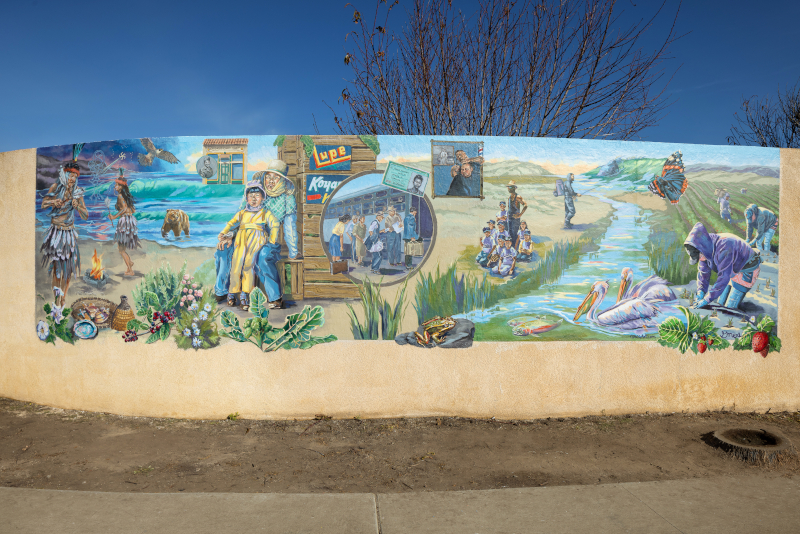
Your fascination with the ocean and coast shines through many of your murals. Can you tell us more about the Coastal Stories mural project commissioned by the Dunes Center and Coastal Conservancy for Guadalupe, CA? How did this project come to life, and how long did it take?
Before picking up a brush, I spent six months in deep research and community interviews, immersing myself in the history and stories of Guadalupe. That meant working with a Chumash expert at the Chumash museum and studying town history and interviews filmed by documentarian Chachi Ramirez. My goal was to amplify the voices of people who rarely get to tell their own history, filtered through my lens as an artist.
The mural begins with the Chumash, the first people, performing the barracuda dance in alignment with the solstice, inspired by an arbor glyph sacred to a local elder who had passed away the year before. From there, I painted the Japanese farmers who shaped this land, and their forced internment during World War II. I included beloved community mentors, women planting strawberries (Guadalupe's primary agricultural crop), and made a point of centering women throughout, since historical murals have so often left them out.
Painted on polytab in my studio, the mural was installed on my birthday in January 2026. It lives on West Main Street near Jack O'Connell Park in Guadalupe, serving as a gateway for everyone heading toward the dunes and the coast.
The overall project was a two-year effort encompassing not just the mural, but multilingual community interviews, documentary filmmaking, and interpretive signage throughout the city. I was also featured in Episode 5 of PBS's Coastal California series — Coastal Stories of the Guadalupe Dunes.
The mural begins with the Chumash, the first people, performing the barracuda dance in alignment with the solstice, inspired by an arbor glyph sacred to a local elder who had passed away the year before. From there, I painted the Japanese farmers who shaped this land, and their forced internment during World War II. I included beloved community mentors, women planting strawberries (Guadalupe's primary agricultural crop), and made a point of centering women throughout, since historical murals have so often left them out.
Painted on polytab in my studio, the mural was installed on my birthday in January 2026. It lives on West Main Street near Jack O'Connell Park in Guadalupe, serving as a gateway for everyone heading toward the dunes and the coast.
The overall project was a two-year effort encompassing not just the mural, but multilingual community interviews, documentary filmmaking, and interpretive signage throughout the city. I was also featured in Episode 5 of PBS's Coastal California series — Coastal Stories of the Guadalupe Dunes.
You recently resumed working on a painting you started 20 years ago. What led to this decision, and what made you finish it after all this time?
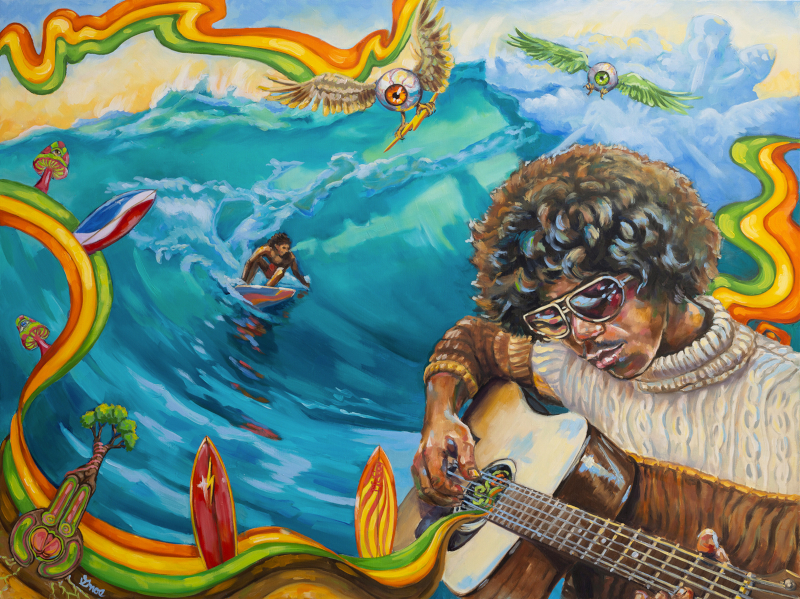
About 20 years ago, I started a painting of Larry Bertlemann — he's playing guitar in the foreground with a scene of him dropping into a massive bomb at Pipeline behind him. Larry and I were friends when I lived in Hawaii, so he felt like a natural subject. But I got really frustrated with the painting. It was done in my old style, and it just wasn't working for me, so I stuffed it up in my mezzanine.
In 2025, artist, surfer, and Huntington Beach Surf Museum curator Rick Blake approached me to create a piece for the Gypsy Tour era of surfing — the 1970s — and something clicked. I had the idea to reimagine the painting in more of a concert-poster style, to capture the color, the energy, and the music of that era. Larry Bertlemann was the perfect subject. He won the Duke Contest in 1974 during the Gypsy Tour era and embodied the spirit of that time like no one else.
Looking back at the decades, some of my greatest sources of inspiration have always been surfing, the ocean, and music. They are woven into everything I do. When Rick's invitation came along, it gave me the perfect reason to finish that painting — now titled "All Aboard the Gypsy Tour: Larry Bertlemann."
The finished piece is part of a major exhibit at the Huntington Beach Surf Museum's brand new space at the library, curated by Pete "PT" Townend, the first-ever world surfing champion, crowned in 1976. The exhibit celebrates the 50th anniversary of professional competitive surfing, and the opening party is in July 2026. It's a pretty incredible thing to be part of.
In 2025, artist, surfer, and Huntington Beach Surf Museum curator Rick Blake approached me to create a piece for the Gypsy Tour era of surfing — the 1970s — and something clicked. I had the idea to reimagine the painting in more of a concert-poster style, to capture the color, the energy, and the music of that era. Larry Bertlemann was the perfect subject. He won the Duke Contest in 1974 during the Gypsy Tour era and embodied the spirit of that time like no one else.
Looking back at the decades, some of my greatest sources of inspiration have always been surfing, the ocean, and music. They are woven into everything I do. When Rick's invitation came along, it gave me the perfect reason to finish that painting — now titled "All Aboard the Gypsy Tour: Larry Bertlemann."
The finished piece is part of a major exhibit at the Huntington Beach Surf Museum's brand new space at the library, curated by Pete "PT" Townend, the first-ever world surfing champion, crowned in 1976. The exhibit celebrates the 50th anniversary of professional competitive surfing, and the opening party is in July 2026. It's a pretty incredible thing to be part of.
You seem to have participated in many group shows over the years. Can you share a story behind an exhibition that really resonated with you?
Two recent museum shows stand out as especially meaningful — the Oceanside Museum of Art and the California Surf Museum. Both felt deeply validating on a personal and professional level. I was able to reconnect with artist friends I hadn't seen in fifteen years. I was in awe of where my work was placed — my pieces hung alongside work by Billy Al Bengston, John Severson, Julian Schnabel, Rick Griffin, and Drew Brophy. To have my work in conversation with artists of that caliber was humbling. And as a woman in this space, where we're still underrepresented, that kind of recognition affirms the path I've chosen.
Art is a subjective expression of the artist's views of life. What has been the most personal project of your career so far? Do you have a theme in mind you'd like to explore in the future?
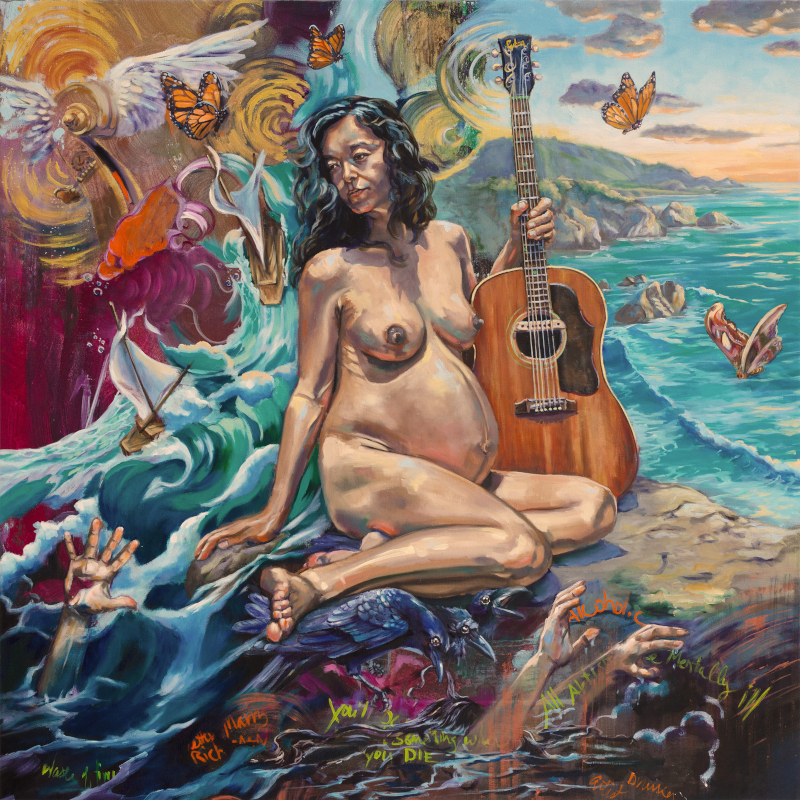
My most personal painting is "Call to Create," which I painted in 2024 during my first year of recovery from alcohol addiction. It depicts a pregnant nude songwriter holding a guitar, with musical instruments swirling around her head that turn into moths, which lead you to the shadow self underneath. Hands reach up and struggle from below, surrounded by derogatory statements I have heard throughout my career and my life — things like "Better marry a rich man" or "You'll be famous when you die." These words affected me deeply, and this painting was my way of confronting these myths about artists. It explores the source of creativity and the shadow self — the parts of us we have to face and reckon with before we can truly create freely.
As for the future, I am incredibly excited to explore Visionary art. I'll be attending a Visionary Art Intensive workshop with Alex and Allyson Grey at the Chapel of Sacred Mirrors, which houses one of the largest collections of Visionary artwork in the world. The sacred painting traditions I will study there are rooted in the belief that the imagination is not random but guided by something the masters call the "mystic eye" — something I actually experienced as a child, before the weight of adult responsibility slowly trained it out of me. Since so much of my career has been built around commission-based work, this feels like an exciting and long-overdue new chapter, one where I get to follow my own creative vision wherever it leads.
As for the future, I am incredibly excited to explore Visionary art. I'll be attending a Visionary Art Intensive workshop with Alex and Allyson Grey at the Chapel of Sacred Mirrors, which houses one of the largest collections of Visionary artwork in the world. The sacred painting traditions I will study there are rooted in the belief that the imagination is not random but guided by something the masters call the "mystic eye" — something I actually experienced as a child, before the weight of adult responsibility slowly trained it out of me. Since so much of my career has been built around commission-based work, this feels like an exciting and long-overdue new chapter, one where I get to follow my own creative vision wherever it leads.
— Colleen Gnos, May 7th, 2026