
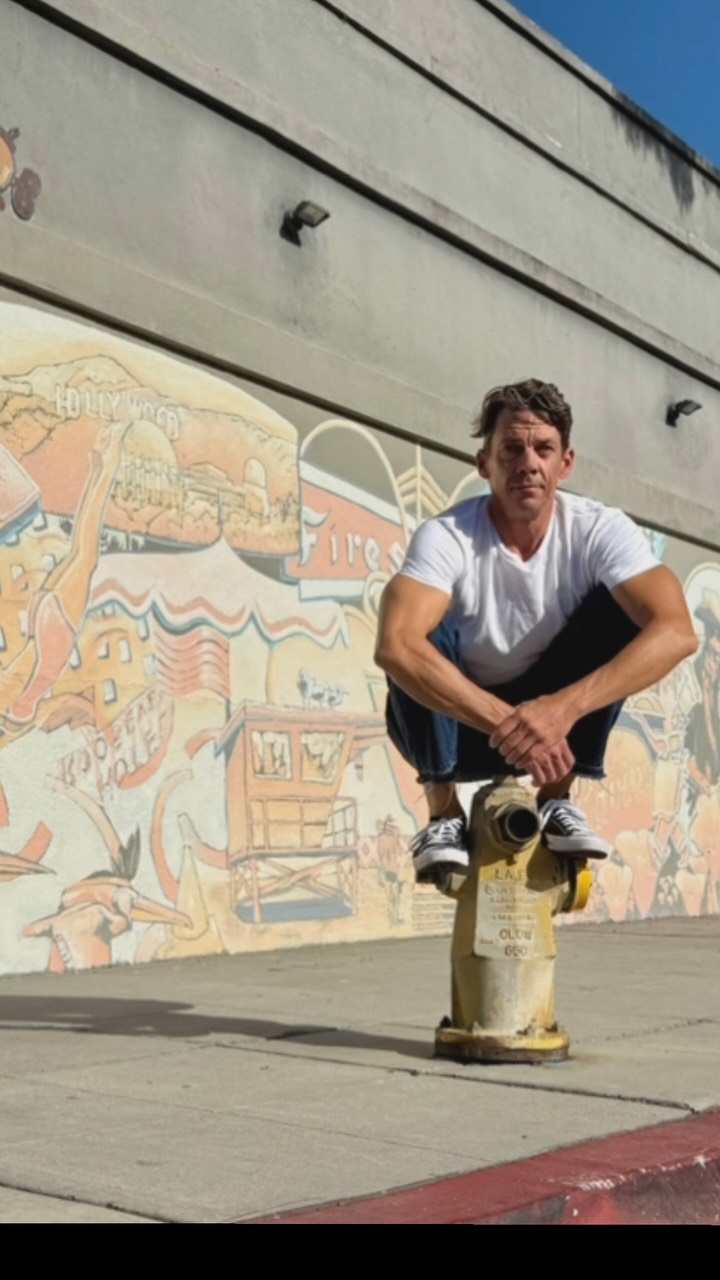
Kevin Johnson is a painter and watercolorist whose work moves between the intimate and the monumental — from 25-minute Moleskine sketches made in a Chateau Marmont locker room to full-scale public murals that draw neighborhood stories out of strangers. Trained in biology and photography before committing to paint, Johnson brings a naturalist's eye and an editor's instinct to everything he sees. We talked with him about clouds, comics, color, Chateau Marmont, and the mercilessness of watercolor.
1. Your background spans photography, painting, and even biology. How do those different disciplines intersect in the way you approach painting today?
Growing up my mom always had her Kodachrome and 35mm. Slide shows were always a big event in the house. My mom would always talk about how to make an image more interesting as she documented our summer vacations in the southwest. I was twelve when I eventually picked up a camera — it felt really natural to compose an interesting frame. Now, when I paint, it's the same process: something catches my eye, I pick a medium to capture it, and I don't really have to think much about composition. It's become pretty automatic.
My degree in biology was a natural fit too. Doing so much camping with my parents let me see and have a deep appreciation for nature. Studying it in college gave me a different type of understanding and put into words and terms many of the things I had been observing and interacting with my whole childhood. When I paint clouds I understand how convection shapes them, so I have a sense of how they move and how to paint that. Dissecting and drawing frogs, cats, sharks, and humans for five years were huge lessons in draftsmanship without formal instruction. Draw what is in front of you — don't complicate it.
My degree in biology was a natural fit too. Doing so much camping with my parents let me see and have a deep appreciation for nature. Studying it in college gave me a different type of understanding and put into words and terms many of the things I had been observing and interacting with my whole childhood. When I paint clouds I understand how convection shapes them, so I have a sense of how they move and how to paint that. Dissecting and drawing frogs, cats, sharks, and humans for five years were huge lessons in draftsmanship without formal instruction. Draw what is in front of you — don't complicate it.
2. You've spent years painting Chateau Marmont from within rather than as an outsider observing it. How has that long-term relationship changed the way you see the space?
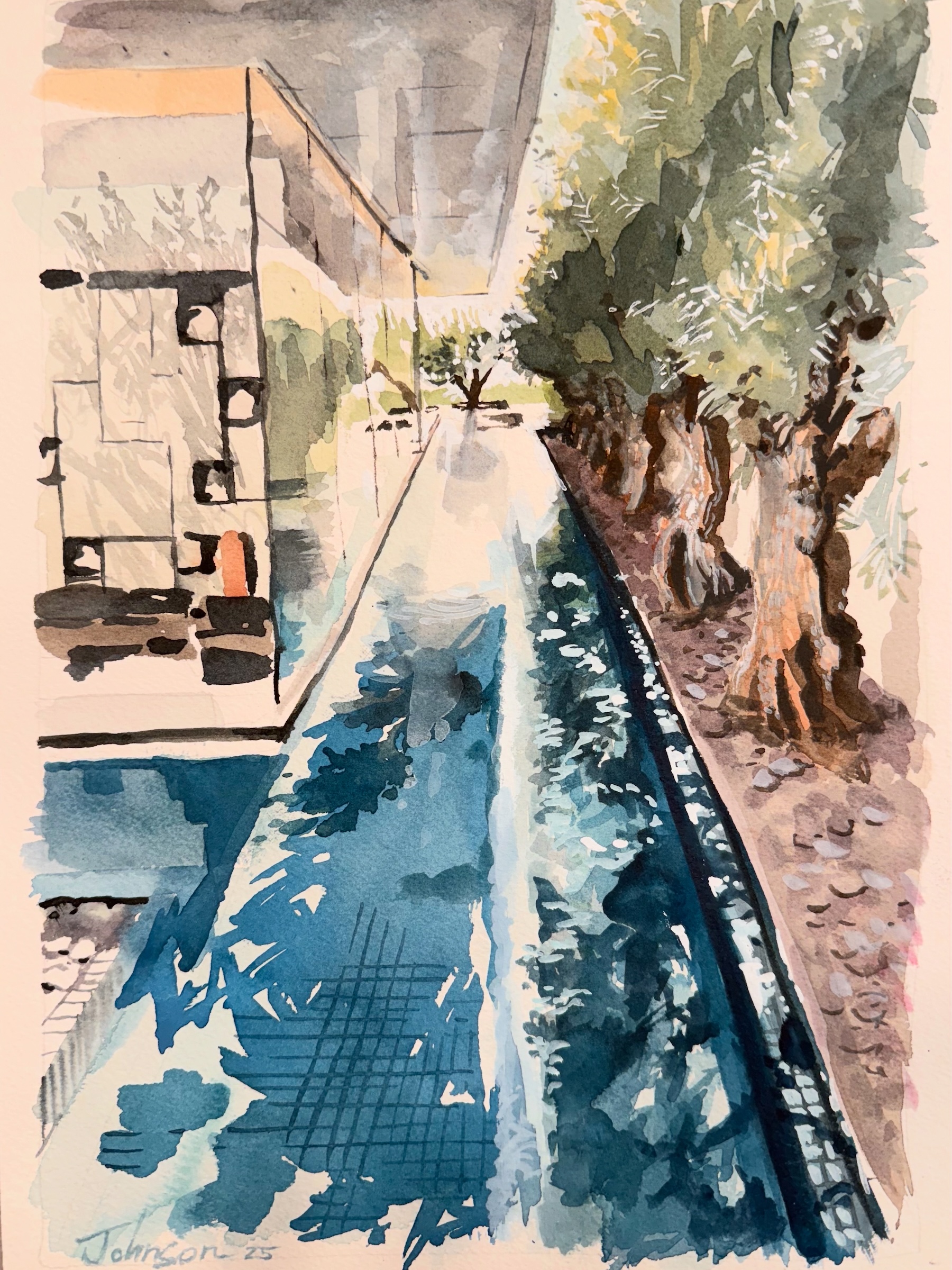
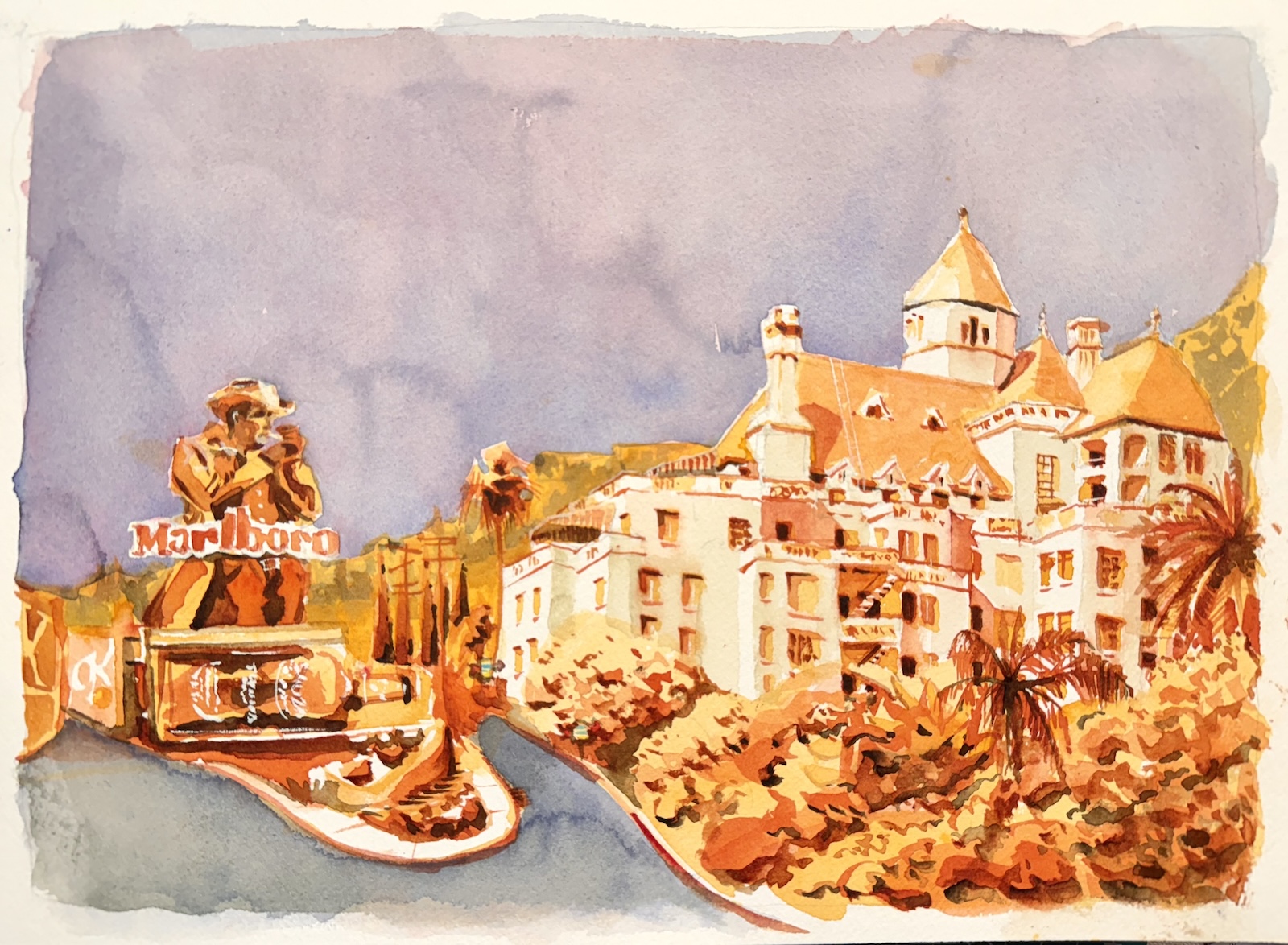
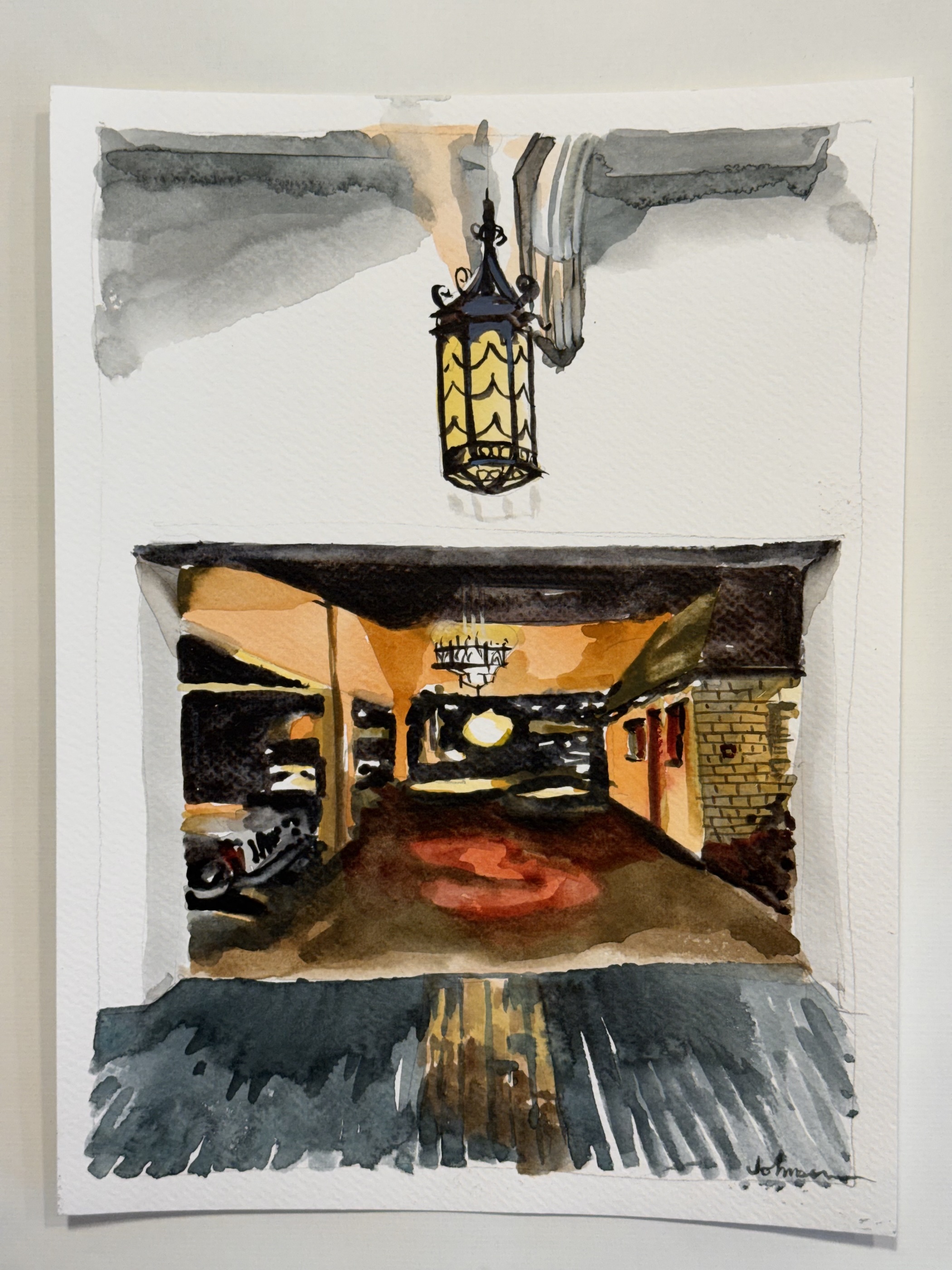
I have a big appreciation for the curation and interior design that Andre and his team have accomplished and how it has evolved over the eighteen years I have been working there. Every space is well considered — the Chateau feels intimate no matter where you sit or look. I began working there in 2009. I was always taking pictures with my phone (shhhh — not allowed), but I didn't start painting and drawing the place till 2016 or so. I started by making 30-minute drawings during my shift breaks. I would bring my markers and Moleskine to work, close myself in the locker room changing room, put some music on, find a pic from the hundreds I had taken, set a timer for 25 minutes, and knock out a drawing. I did this consistently for the next three or four years. I would look forward to it every night — it gave me a bigger appreciation and love for the place.
3. Your work often feels cinematic, as though something has just happened — or is about to happen. Are you consciously thinking about narrative when composing a painting?
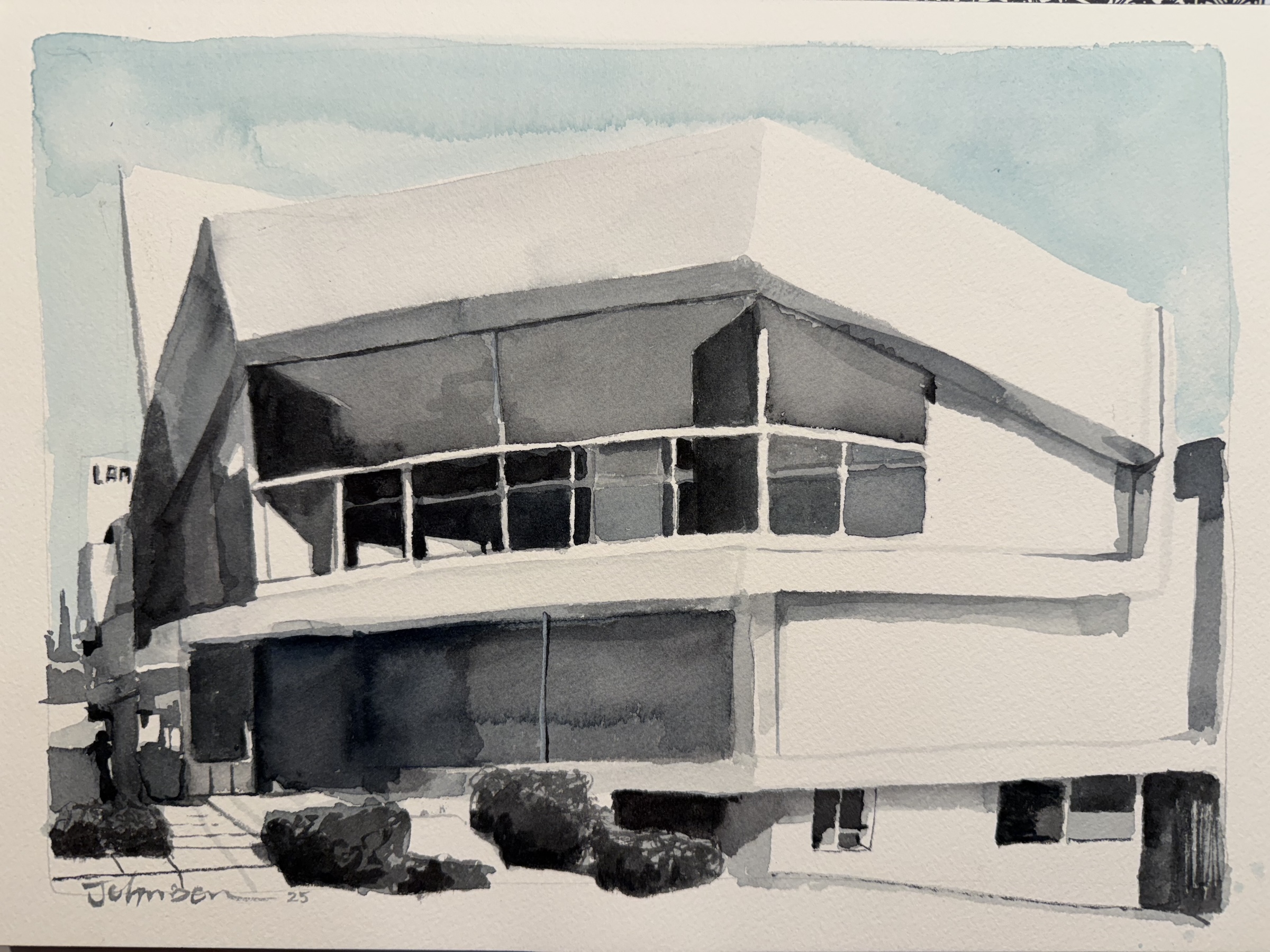
My composition choices are on instinct, and some combination of what my mom taught me as well. I see a scene before me and I find the "it" there, and then paint, draw, take a pic, or commit it to memory to use later. I think a lifetime of reading comics and graphic novels taught me a lot about distillation — saying the most in the simplest way.
This question made me think of a related moment from art school at the University of Arizona. In 1996 I began studying photography there after two years at Columbia College in Chicago. Ken Shorr, my photo professor, asked me to take a portfolio of my black-and-white Tucson street photos to the painting and drawing professor Chuck Hitner. Ken said, "your photos look like drawings." I didn't understand why, but I did as he asked. After showing Chuck, he asked me to enroll in his class the following semester — and I started painting full time. I think there is a thread there that speaks to the stillness or tension that I can see in my drawings and paintings.
This question made me think of a related moment from art school at the University of Arizona. In 1996 I began studying photography there after two years at Columbia College in Chicago. Ken Shorr, my photo professor, asked me to take a portfolio of my black-and-white Tucson street photos to the painting and drawing professor Chuck Hitner. Ken said, "your photos look like drawings." I didn't understand why, but I did as he asked. After showing Chuck, he asked me to enroll in his class the following semester — and I started painting full time. I think there is a thread there that speaks to the stillness or tension that I can see in my drawings and paintings.
4. You've described your process as one of editing and distillation. At what point does a painting finally feel "resolved" to you?
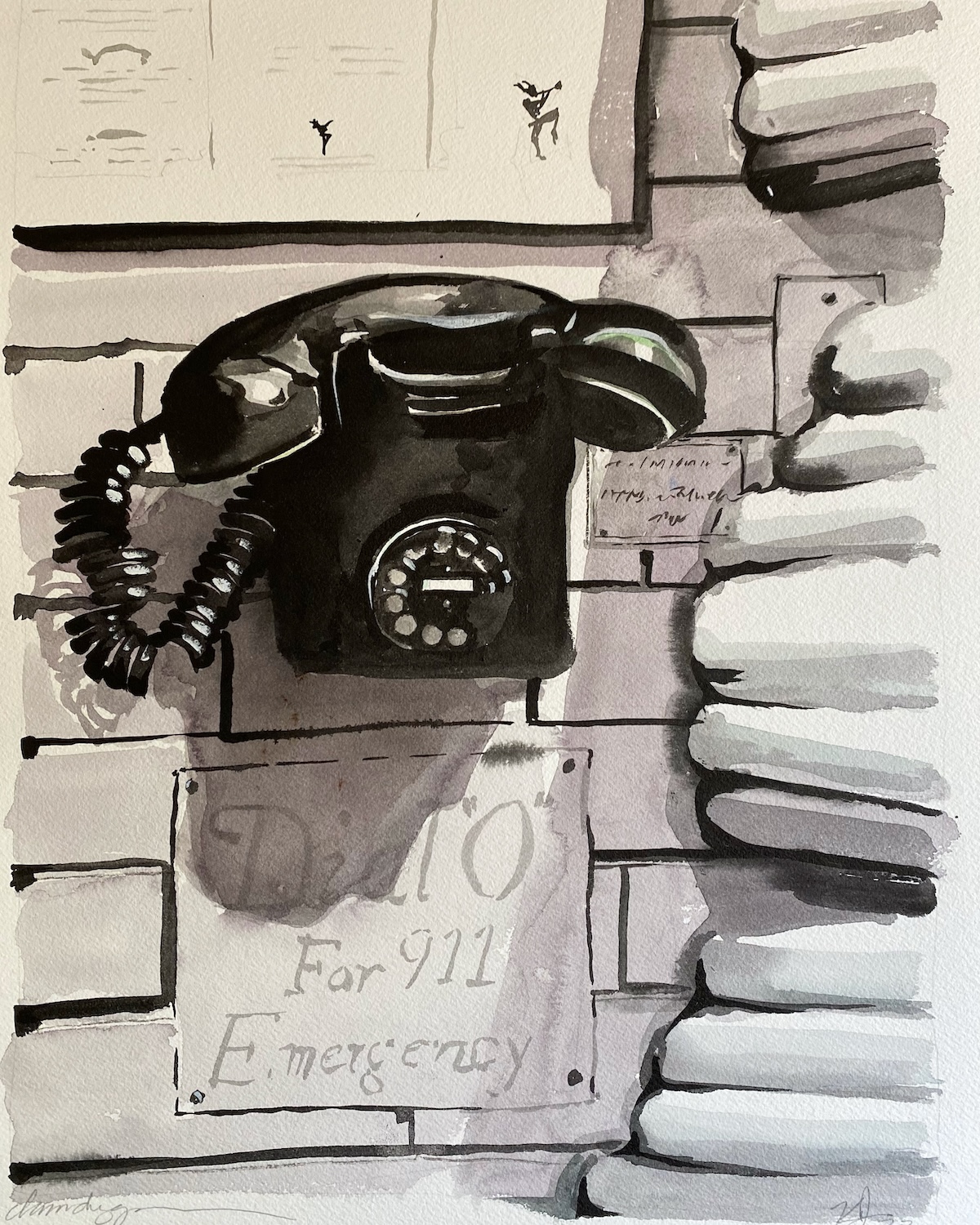
I am constantly learning when this point happens. Sometimes it's immediately after I get the thing down on the paper or canvas that caught my eye in the first place. Other times some secondary player in the painting — like a tree, or a texture on a brick, or a shadow — just comes alive and all of a sudden the entire image snaps into place.
I also find it helpful to leave the studio right after I get the feeling of "done" and go take a bike ride or a walk and then come back. It keeps me from touching something too much, which kills the magic in a painting in seconds. The break also gives me fresh eyes to look at what I just made — to see if I was onto something or if it's all artifice and just falls flat.
I also find it helpful to leave the studio right after I get the feeling of "done" and go take a bike ride or a walk and then come back. It keeps me from touching something too much, which kills the magic in a painting in seconds. The break also gives me fresh eyes to look at what I just made — to see if I was onto something or if it's all artifice and just falls flat.
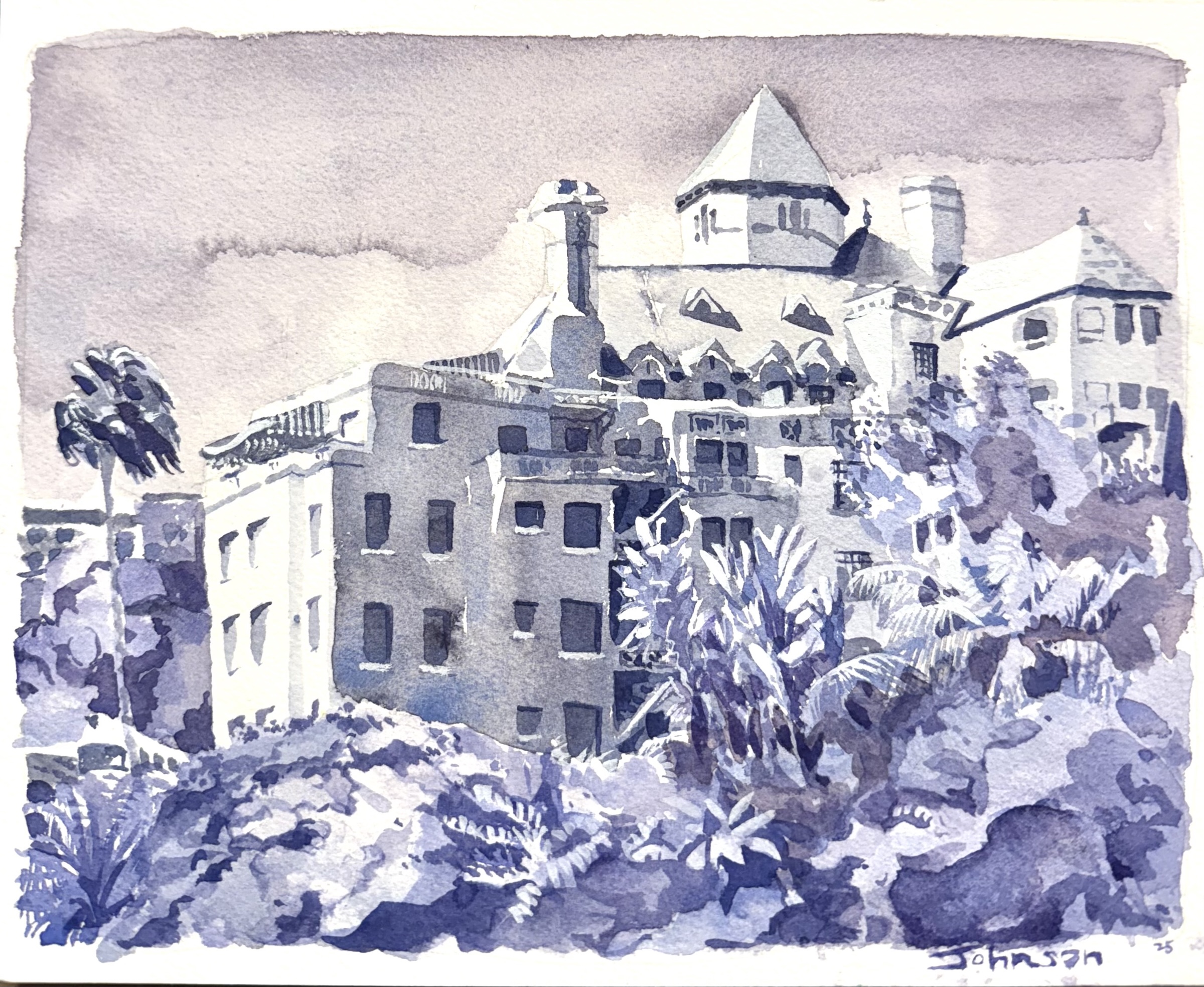
5. Los Angeles is often portrayed through spectacle or nostalgia, but your paintings feel quieter and more intimate. What version of LA are you most interested in capturing?
I resisted painting and drawing the Chateau when I first came to LA and started working there. It was a "famous" spot and felt like an easy target — I was busy painting and drawing all the flora and fauna of the California chaparral, Mojave desert, and Pacific coast. Well, seven years later the Chateau became a full-on muse, as I mentioned.
Around that time I came across Ed Ruscha's piece Every Building on the Sunset Strip, 1966. I saw how much had changed in a really short time and wondered how long everything else would last. So I started documenting it all — Greenblatt's Deli, Lytton Savings, Tower Records that became Supreme, and The Viper Room is in the gunsights next. All the older places have so much more style and history. They catch my eye right away.
Around that time I came across Ed Ruscha's piece Every Building on the Sunset Strip, 1966. I saw how much had changed in a really short time and wondered how long everything else would last. So I started documenting it all — Greenblatt's Deli, Lytton Savings, Tower Records that became Supreme, and The Viper Room is in the gunsights next. All the older places have so much more style and history. They catch my eye right away.
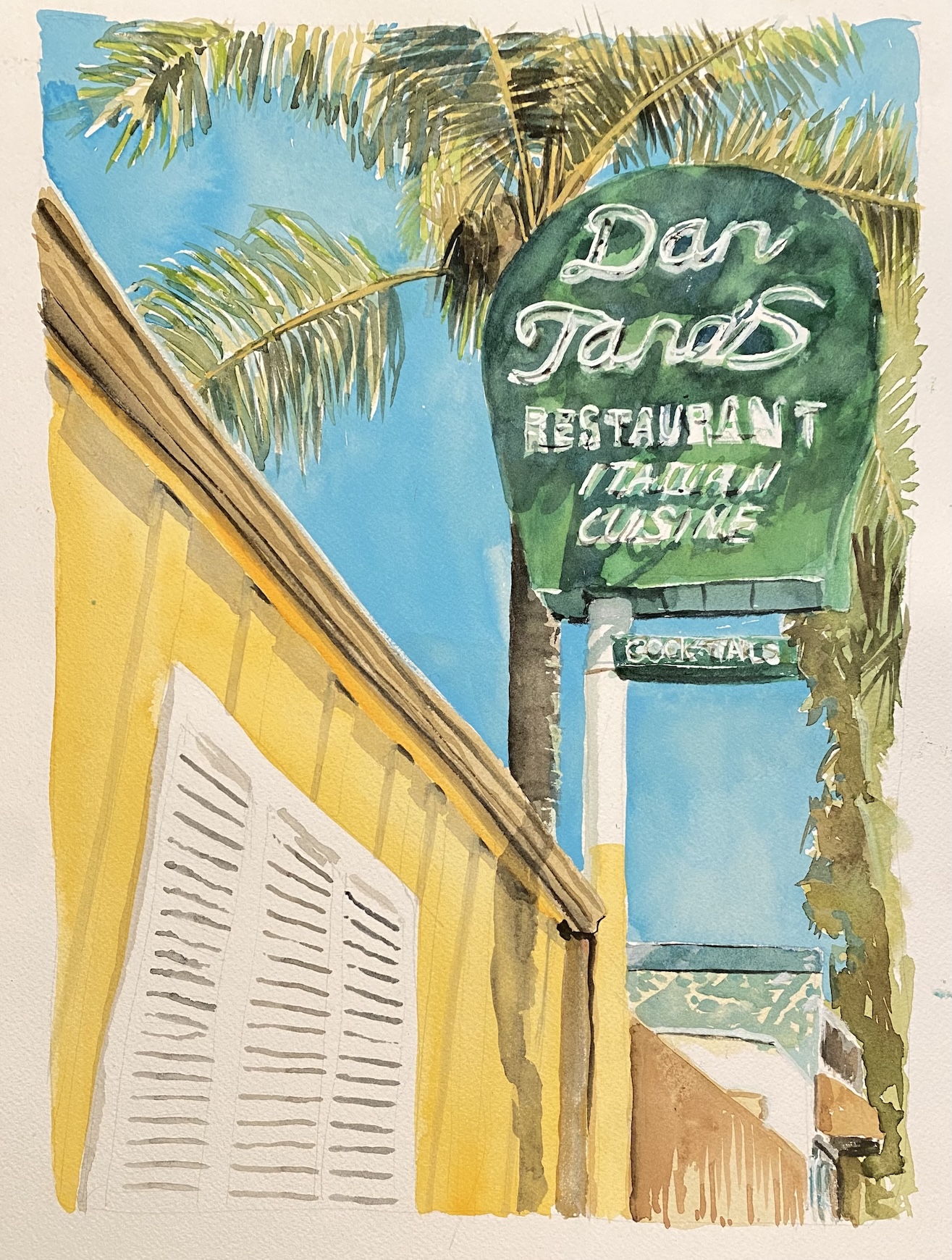
6. Your palettes are often restrained yet emotionally rich. How do you decide what to leave out of an image?
I had a lesson I learned from the painter John Wenger from New Mexico back in 1997. He talked a lot about personal color — the next step beyond tertiary. The idea was getting to combinations of color that went beyond the color wheel and became personal for you. For example, I love staring at a scene and seeing the slight purple edge on a shadow cast on an orange wall. I don't think it would show up in a photo, but I see it, and it gives me more to play with and tell the story.
I don't do too much editing of what is in front of me as I consider an image. I like capturing all of the wires, the stop signs, and owl decoys out there — that stuff completes the story. Every once in a while I'll pick out one, two, or three colors and make a piece with a tiny palette just to see what I can pull off.
I don't do too much editing of what is in front of me as I consider an image. I like capturing all of the wires, the stop signs, and owl decoys out there — that stuff completes the story. Every once in a while I'll pick out one, two, or three colors and make a piece with a tiny palette just to see what I can pull off.
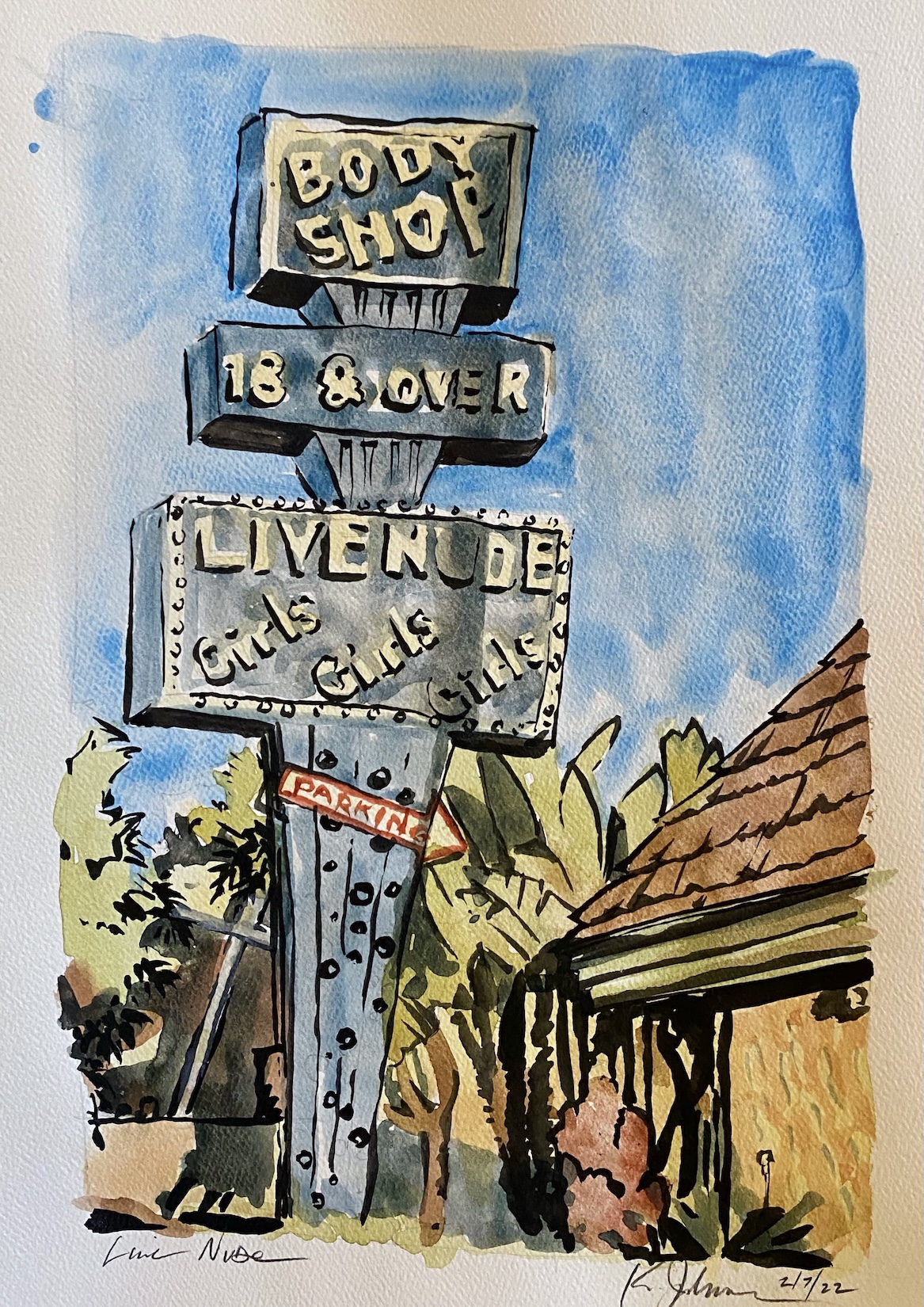
7. How does your mindset shift when moving from intimate watercolor work to large-scale public murals like Macaulay's Alibi?
When I paint a mural it usually starts as a sketch — some abstract marks on a napkin with a Sharpie is my favorite. I map out the big directional movements, the pace of the composition. Then I start sketching and making watercolors, drawing and redrawing, getting familiar with the forms and the layout.
Simplification is the most important thing for me, and remembering: will this thing that is one inch on the drawing look good five feet across? How can I model it with light to keep it interesting and engaging but simpler at the same time? I'm always paying close attention to the negative space in murals, because everything is so much more pronounced. Technically the mural is easier — acrylic dries fast; if you make a wrong move, paint it out and start again. Watercolor is merciless.
The other huge factor is the performative quality of a public mural. People come up and talk to you, telling me "thank you for doing this!" — and because of the subject matter in Macaulay's Alibi, people of the neighborhood told me all kinds of stories about places they have seen or are sad about others that are gone as they walked by. It's also a lot more vulnerable painting on the street than sitting in a studio making a watercolor — but I love both.
Simplification is the most important thing for me, and remembering: will this thing that is one inch on the drawing look good five feet across? How can I model it with light to keep it interesting and engaging but simpler at the same time? I'm always paying close attention to the negative space in murals, because everything is so much more pronounced. Technically the mural is easier — acrylic dries fast; if you make a wrong move, paint it out and start again. Watercolor is merciless.
The other huge factor is the performative quality of a public mural. People come up and talk to you, telling me "thank you for doing this!" — and because of the subject matter in Macaulay's Alibi, people of the neighborhood told me all kinds of stories about places they have seen or are sad about others that are gone as they walked by. It's also a lot more vulnerable painting on the street than sitting in a studio making a watercolor — but I love both.
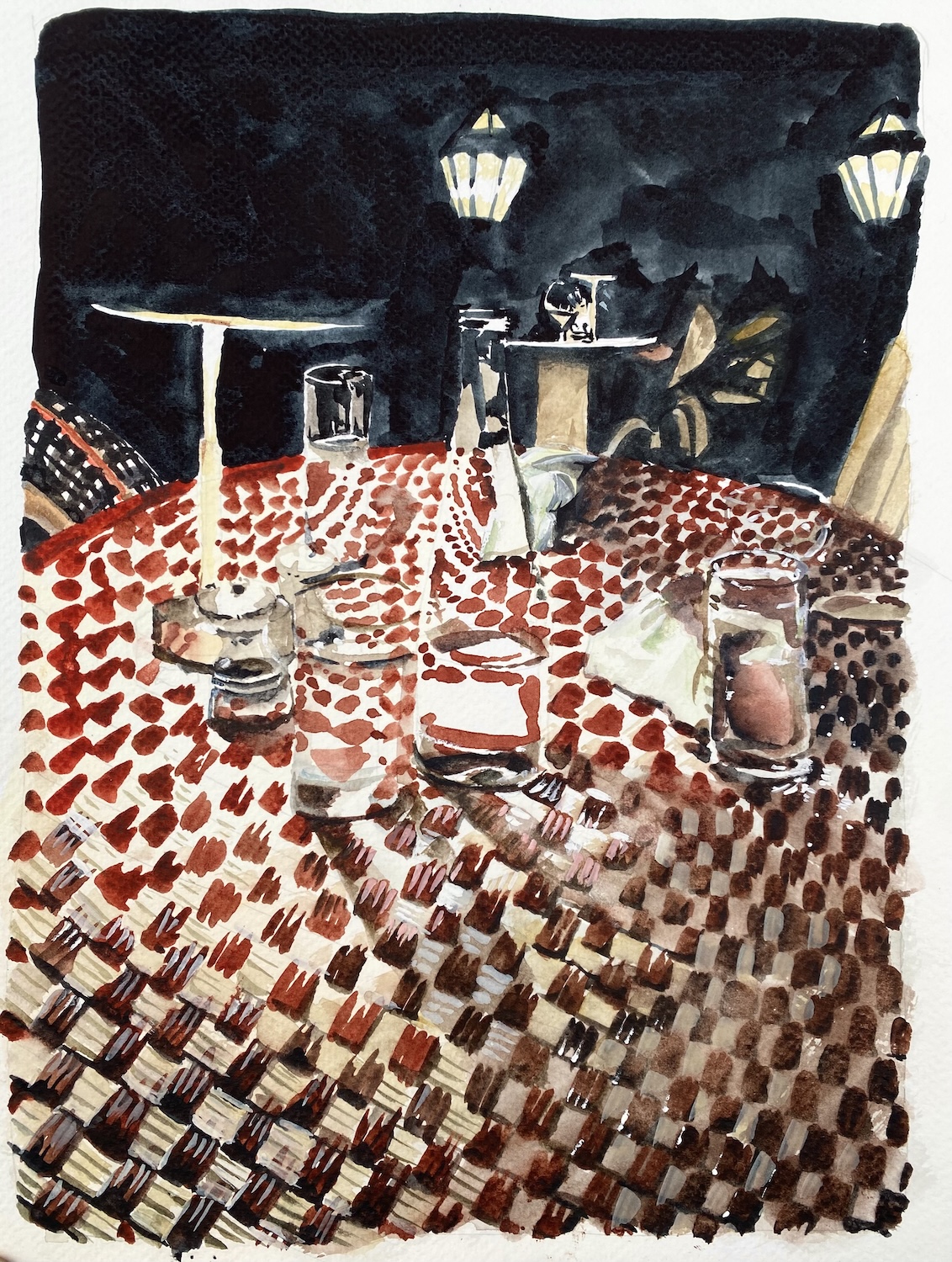
8. After revisiting the same places and subjects over many years, what continues to surprise or inspire you creatively?
I find that I need less. I see something new in something I've painted hundreds of times — like the Chateau. I get inspired constantly. Having enough time to make it all is the only thing that stops me.
Follow Kevin on Instagram at @inthestixx